Creating a small test layout in N-scale can be a great way to practice scenery and track laying techniques before moving on to a larger HO layout. I inherited from my father a set of N-scale track, switches, scenery, and trains that he had previously created many years ago. He also built a larger HO-scale setup that I plan to disassemble in order to reuse the track and accessories but to start I had a handful of N-scale equipment. It has been 25+ years since I’ve worked on a model railroad, so I decided it would be a good idea to create a small N-scale model railroad for practicing scenery and track laying, with the intention of eventually moving on to a larger HO layout.
To start out, I had a variety of right and left switches, some flex track, and a variety of smaller fixed-length pieces. There was also a small variety of buildings I could use, including a yard building, train station, small store, and some other industrial buildings. I wasn’t going to be building a grand masterpiece but I knew getting some practice in building and decorating scenery was in order.
Planning
Before beginning construction on your model railroad, it is important to spend some time planning and designing the layout. This includes deciding on the size and shape of the layout, as well as the theme and era you want to model. In my case, I had a fixed amount of track and didn’t want to spend much buying more track since this was a test layout, so I stuck with a 2′ x 4′ board that I found at Home Depot. In most cases, you’ll likely be constrained by housing limitations and negotiating a location with other members of your house, but also it can be helpful to start smaller if you’re new to the hobby. It may not be a good idea to take on a huge layout project before you have an understanding of all the facets of modeling and to determine if you have the desire to stick with it.
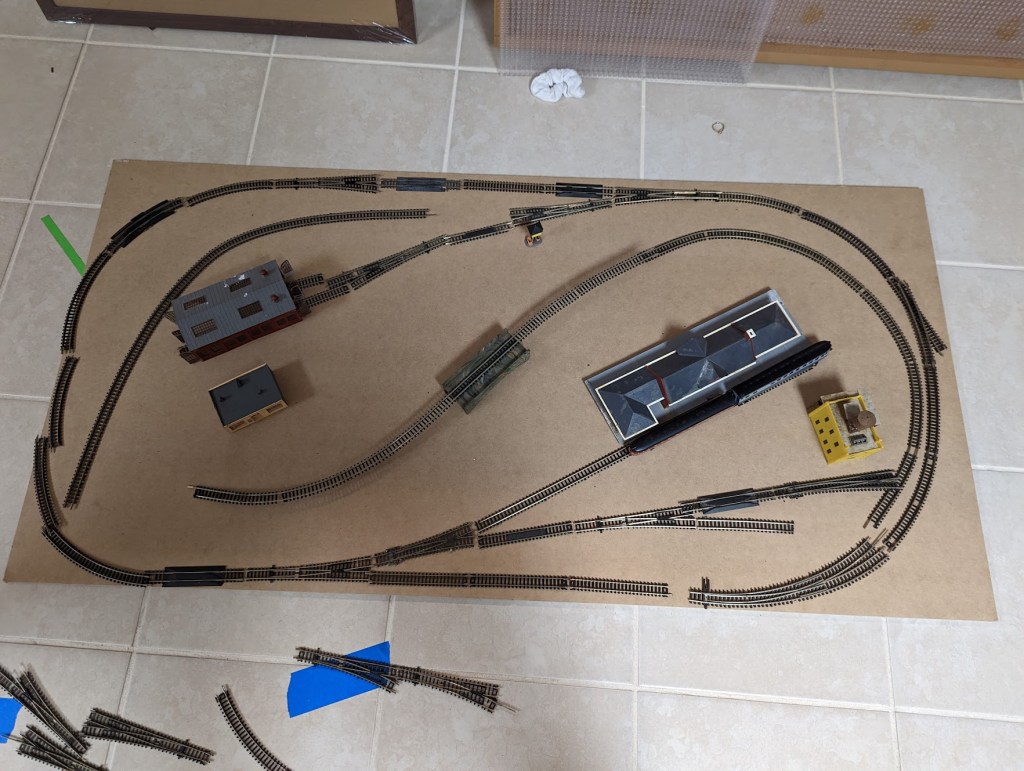
As you can see above, I had just enough track to fit around the board. Since it was such a small layout, doing this method of planning was good enough for my purposes. I watched a lot of YouTube videos on N-scale layouts to get an idea of the direction I wanted to take. Getting all of the track to stay in place in my scenario was more difficult while planning because I had a variety of flex track, but depending on the track approach you choose there may be easier methods. For example, if you choose to use Kato Unitrack for your layout, the track pieces snap together but can also be easily disconnected, which can make your planning easier.
Overall, this physical method of track modeling worked for me, however, you should consider using software tools to help you visualize and plan your design before committing to any physical construction on larger layouts. When I start working on my larger HO-scale layout, I plan to do more detailed planning before construction. Some of the leading software I’ve found in my research for modeling are AnyRail and SCARM. Both have free versions that you can use with some limits, but if you want to model past a certain number of track pieces you may want to consider paying.
Another Approach
Creating a diorama could also be a great way to improve your modeling skills, particularly when it comes to scenery and detailing. Dioramas are typically smaller in size than model railroad layouts, so they offer an opportunity to focus on the details and really make each element stand out. An interesting thing about this hobby is that you can choose to be as creative as you would like. Some may want to make the scenery as simple as possible and just get to running trains, but there are also some masterpieces out in the world that you’ll see features in videos or Model Railroader articles. By creating a realistic and visually appealing diorama, you can learn how to work with different materials, experiment with color and texture, and refine your techniques for creating realistic scenery.
In addition, building a diorama can help you develop your storytelling skills. By creating a scene that tells a story, you can learn how to convey a sense of narrative through your modeling work. This can be particularly useful when it comes to building model railroad layouts, as a well-designed layout should be able to tell a story and capture the imagination of the viewer. This is especially true if you are choosing to model a certain era or prototype railroad.
Overall, when you start your modeling journey, you may want to consider practicing your skills with a small layout or diorama. It will enable you to perfect various techniques like track-laying, sculpting, painting, and scenery creation and prepare for a larger layout you plan to build in the future. And who knows, you might just discover a new passion for creating miniature worlds!
 My Model Railroad